
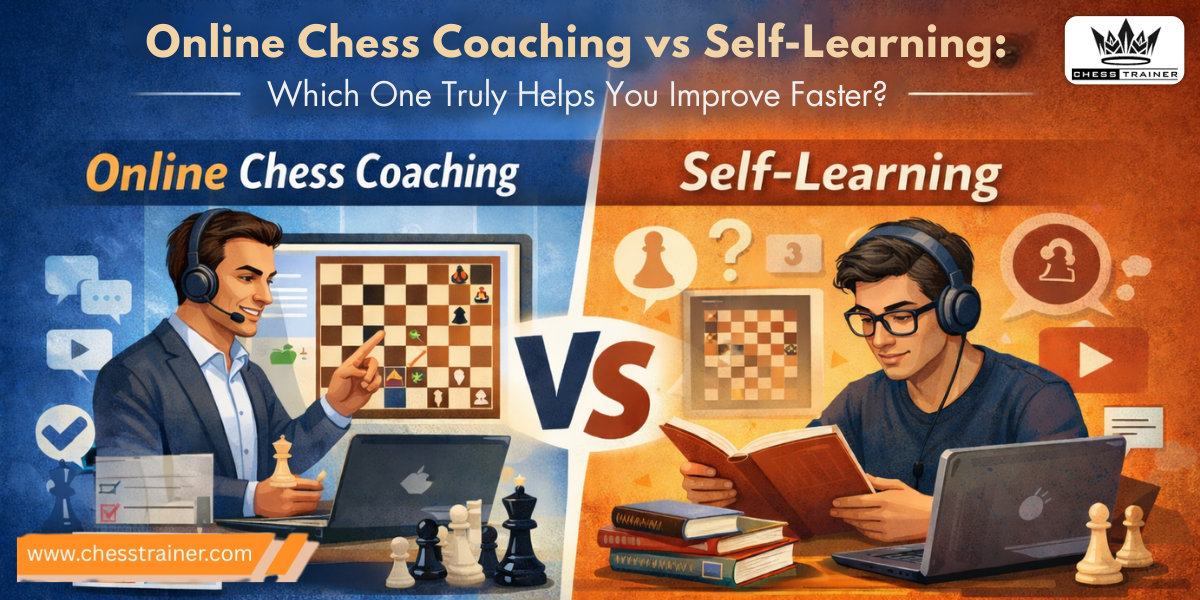
Online Chess Coaching vs Self-Learning: Which One Truly Helps You Improve Faster?

Chess is a game of strategy, patience, and deep calculation. But when it comes to improving your skills, one big question arises — Online Chess Coaching vs Self-Learning, which is the better path?
Many players begin their journey watching YouTube videos, solving puzzles, and reading books. While this method can work to some extent, structured improvement often requires guidance. In this blog, we will deeply analyze Online Chess Coaching vs Self-Learning, compare their advantages, and help you decide the best path for serious chess skill development.
If your goal is faster rating growth and structured progress, this comparison of Online Chess Coaching vs Self-Learning will give you clarity.
Understanding Self-Learning in Chess
Self-learning means studying chess independently using:
- YouTube tutorials
- Chess books
- Puzzle apps
- Online practice games
- Free resources
Many players prefer this approach because it feels flexible and cost-effective. However, while self-learning builds independence, it often lacks structure.
Without proper direction, players:
- Repeat the same mistakes
- Focus too much on openings
- Ignore endgame fundamentals
- Skip positional understanding
When comparing Online Chess Coaching vs Self-Learning, the biggest difference lies in structure and feedback.
What Is Online Chess Coaching?
Online chess coaching involves learning directly from an experienced coach through digital platforms. Sessions may include:
- One-on-one classes
- Group training
- Game analysis
- Tournament preparation
- Tactical and strategic planning
A professional Online chess coaching program provides structured lessons, personalized feedback, and systematic progress tracking.
When discussing Online Chess Coaching vs Self-Learning, the structured approach of online coaching stands out immediately.
Key Differences: Online Chess Coaching vs Self-Learning
Let’s break down the comparison in practical terms.
1️⃣ Structure vs Random Learning
Self-learners often jump from topic to topic. One day openings, next day tactics, then random blitz games.
In contrast, Structured chess training ensures you follow:
- Opening principles
- Middlegame plans
- Endgame techniques
- Tactical patterns
- Strategic themes
With Structured chess training, improvement becomes measurable and organized. This is one of the strongest arguments in Online Chess Coaching vs Self-Learning debates.
2️⃣ Feedback and Mistake Correction
One of the major drawbacks of self-learning is lack of correction. You may think your move was correct, but without expert review, you repeat errors.
Through Guided chess learning, coaches analyze your games and identify:
- Tactical blind spots
- Poor time management
- Weak pawn structures
- Bad piece coordination
This kind of Guided chess learning accelerates progress dramatically.
In the comparison of Online Chess Coaching vs Self-Learning, feedback is the game-changing factor.
3️⃣ Personalized Learning Experience
Every chess player has different strengths and weaknesses.
An experienced Online chess trainer evaluates:
- Your rating level
- Playing style
- Tactical ability
- Endgame knowledge
A professional Online chess trainer then designs a plan suited specifically for you.
Self-learning, on the other hand, follows generic content. That’s where Personalized chess skill development becomes more effective through coaching.
When analyzing Online Chess Coaching vs Self-Learning, personalization gives coaching a clear edge.
4️⃣ Faster Rating Improvement
If your goal is to increase your rating, then Chess improvement with coaching tends to be faster.
Why?
Because Chess improvement with coaching includes:
- Regular practice assignments
- Weekly performance tracking
- Tournament strategy preparation
- Mistake pattern identification
Players under Professional chess coaching typically improve quicker than self-taught players because they follow a proven roadmap.
This is why in the discussion of Online Chess Coaching vs Self-Learning, coaching wins when speed matters.
5️⃣ Motivation and Accountability
Self-learning requires high discipline. Many players start enthusiastically but stop after a few weeks.
With Online chess classes, you have:
- Scheduled sessions
- Homework tasks
- Performance reviews
- Continuous monitoring
Regular Online chess classes create accountability and maintain consistency.
Consistency leads to better Chess skill development over time.
In the debate of Online Chess Coaching vs Self-Learning, accountability becomes a decisive factor.
Benefits of Online Chess Coaching

Let’s explore the specific benefits of online chess coaching in detail.
✔ Structured Progression
The biggest Benefits of online chess coaching is structured learning.
Instead of random study, you follow a step-by-step progression:
- Opening preparation
- Tactical training
- Positional understanding
- Endgame mastery
These Benefits of online chess coaching ensure balanced growth.
✔ Expert Game Analysis
Under Professional chess coaching, your games are deeply analyzed.
Coaches help you understand:
- Why a move failed
- What alternative plan was better
- How to avoid similar mistakes
This is a core element of Guided chess learning.
✔ Tournament Preparation
Preparing alone for tournaments can be overwhelming. With Online chess coaching, players receive:
- Opening repertoire building
- Opponent preparation
- Time management training
- Psychological readiness
These are strong Benefits of online chess coaching rarely available through self-learning.
✔ Customized Training Plans
Through Online chess coaching, every student gets:
- Targeted exercises
- Skill-specific puzzles
- Performance evaluation
This makes Chess skill development faster and more efficient.
When Self-Learning Might Work
To be fair in the discussion of Online Chess Coaching vs Self-Learning, self-learning can work for:
- Casual players
- Hobby learners
- Players not focused on rating
- Budget-conscious beginners
However, even beginners benefit greatly from Chess coaching for beginners, especially in understanding fundamentals correctly.
Why Chess Coaching for Beginners Matters
Many think beginners don’t need coaching. That’s a myth.
Chess coaching for beginners ensures:
- Proper foundation
- Correct tactical training
- Understanding of key principles
- Avoiding early bad habits
Early exposure to Chess coaching for beginners results in stronger long-term performance.
In the comparison of Online Chess Coaching vs Self-Learning, beginners often progress faster with guidance.
The Role of Online Chess Classes in Modern Learning
Technology has transformed education. Today, Online chess classes offer:
- Screen sharing for live analysis
- Game database reviews
- Interactive exercises
- Recorded sessions for revision
With flexible scheduling, Online chess classes provide global access to expert coaches.
That’s why Online Chess Coaching vs Self-Learning now heavily favors online coaching in today’s digital era.
Structured Chess Training: The Backbone of Improvement
Improvement without structure is slow.
Structured chess training includes:
- Weekly goals
- Tactical modules
- Positional themes
- Endgame drills
Repeated exposure to Structured chess training builds strong fundamentals and reduces rating plateaus.
Guided Chess Learning: The Smarter Way to Train
Unlike self-study, Guided chess learning offers real-time correction and clarity.
With Guided chess learning, you understand:
- Strategic concepts deeply
- Positional sacrifices
- Long-term planning
- Practical decision-making
In Online Chess Coaching vs Self-Learning, guided learning significantly reduces confusion.
Professional Chess Coaching and Long-Term Growth
Serious players aiming for tournaments benefit from Professional chess coaching.
It includes:
- Advanced opening theory
- Deep positional analysis
- Competitive preparation
- Psychological training
Repeated exposure to Professional chess coaching builds tournament confidence and competitive mindset.
Chess Skill Development: Which Path Is Better?
True Chess skill development requires:
- Tactical accuracy
- Positional understanding
- Endgame knowledge
- Psychological stability
While self-learning may improve tactics, balanced Chess skill development usually comes through structured coaching.
That’s why, when analyzing Online Chess Coaching vs Self-Learning, coaching supports holistic growth.
Final Verdict: Online Chess Coaching vs Self-Learning
So, which one should you choose?
If you are:
- Casual → Self-learning is okay
- Competitive → Coaching is better
- Rating-focused → Coaching is faster
- Serious about mastery → Coaching is essential
The debate of Online Chess Coaching vs Self-Learning ultimately depends on your goals. However, for faster improvement, structured growth, and professional guidance, online coaching clearly has the upper hand.
If your ambition is real improvement, Online Chess Coaching vs Self-Learning becomes less of a question and more of a strategic decision.
Conclusion
Chess is not just about moving pieces — it’s about thinking systematically. While self-learning offers flexibility, Online chess coaching provides structure, accountability, expert guidance, and measurable progress.
In the ultimate comparison of Online Chess Coaching vs Self-Learning, coaching stands out for players who want faster rating growth, deeper understanding, and long-term success.
If improvement is your priority, investing in coaching could be the smartest move you ever make — both on and off the board.
Also Read: How to Improve Your Chess Rating with Online Training
👉 Follow Us on Social Media! Stay Connected & Stay Ahead! 👇
📘 Facebook || 📸 Instagram || 💼 LinkedIn || 🎯 Twitter || 📌 Pinterest